The Iowa County Historical Society invites the general public to its
Annual Fall Meeting
Featuring guest speaker Alex Harrington,
Chief Meteorologist for WISC-TV and FOX in Madison
Saturday, October 17, 2026, beginning at 1 pm
Barneveld Lutheran Church
505 Swiss Lane, Barneveld
Path of Destruction: The Barneveld Tornado of June 8, 1984
Chief Meteorologist Alex Harrington will present a vivid description with a weatherman’s insight of the devastating 1984 Barneveld Tornado.
Mr. Harrington’s passion for weather began at age four on his family farm in Arena, Wisconsin, where early exposure to the power of nature shaped a lifelong commitment to keeping communities informed and safe. He grew up just 10 miles north of Barneveld and has always been fascinated by this tornado, one of the strongest in Wisconsin, that almost completely destroyed the entire village of Barneveld, along with the loss of lives. He did considerable research on the tornado while in graduate school at the University of Wisconsin in Madison. He was the first meteorologist to piece together what happened in the Midwest, what happened in Wisconsin, and what happened locally near Barneveld that led to such a historic tornado, and he is referenced as an expert on the unique storm.
Alex leads the weather team at Channel 3, and also teaches business courses at Edgewood University, bringing real-world management insight into the classroom. He holds undergraduate and graduate degrees in Atmospheric and Oceanic Sciences from UW–Madison, along with an MBA from Edgewood College. He was also just recently nominated again for Best of Madison in the TV Personality category.
Following the presentation, anyone who would like to share a memory of that day will be able to do so. Alex will be open to answer questions. Refreshments and snacks will be served.
Download a printable flyer (PDF) to share with others.
Visit the Museum!
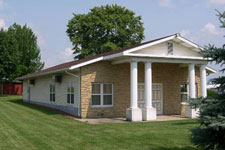 The Iowa County Historical Society works to discover and preserve the history of Iowa County, Wisconsin. We maintain a wide variety of archival items including:
-
- Historical photo collections of life in Iowa County
- Obituary files and cemetery records
- Family genealogy collections including oral histories
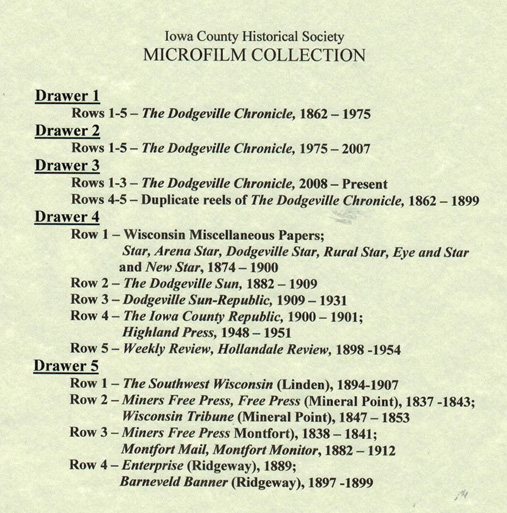
- Microfilm of Iowa County newspapers
- Iowa County Plat Books
- Artifacts and scrapbooks from Iowa County’s past
- Dodge Mining Camp Cabin and the Floyd School
- Archives of Iowa County surnames
- Reprints of Iowa County history books
Visitors are welcome! Our hours are Wednesday through Friday, 1 pm to 4 pm. Inclement weather affects our hours: If public schools close, we close. The Museum is located at 1301 N. Bequette St., Dodgeville, WI. Our Mailing address is P.O. Box 44, Dodgeville, WI 53533; Phone number (608) 935-7694; Email: ichistory@mhtc.net
Iowa County History Facts
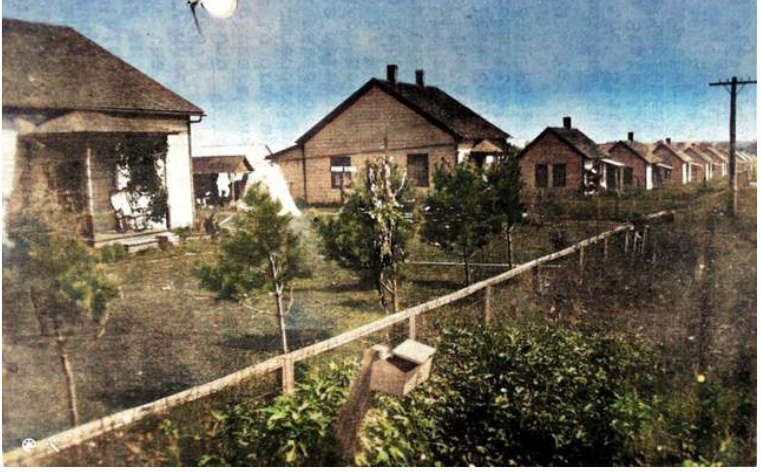
Stringtown mining settlement near Rewey.
The first white residents were of English, Irish, Scots, and French descent from Kentucky, Missouri, or adjacent states. The Panic of 1819 started miners moving up the Mississippi River. The end of the Winnebago war in 1827, was seen as an opportunity for miners to spread into Iowa County. Word quickly spread that lead deposits so abundant in this area that ore lay on top of the ground!
In 1827, Henry Dodge, his family, and about 40 miners set up camp in the vicinity. Within a short time, about 100 miners were working claims on the ridges of Dodgeville. By 1829, more than 4,000 miners worked in southwestern Wisconsin, producing 13 million pounds of lead a year. By the mid-1830s, news of the “lead rush” in the Upper Mississippi Valley had reached England; and a steady stream of skilled, hard-rock miners from Cornwall and Wales had begun.
Lead mining in the area went into decline during the 1850s. Many of the Cornish moved on to the copper mines of Upper Michigan, the silver mines of Colorado, and the gold mines of California. Mining was replaced by farming and mercantilism.